
Desk & Office Guides
Gel Pens, Decoded: Tip Size, Pack Size, and How Many You Actually Need
Nov
Disclosure: this site earns a commission from qualifying purchases made through the links below, at no extra cost to you.
Open the drawer and count the pens. Most people find eight or nine of them, three that write, and no clear idea which one they actually like. The five pens in this cluster all say “gel pen” on the box, they are all roughly the same object, and they still sell at different prices to different people for good reasons. Here is how the differences actually break down, so you can buy one box instead of five.
The only three specs that decide anything
Pen packaging is loud and uninformative. Underneath the adjectives, a gel pen is defined by three numbers, and almost every bad purchase is a mismatch on one of them.
Tip width — how much ink lands on the paper, measured in millimetres. This is the number printed next to “fine point” or “extra fine”, and it changes your handwriting more than the brand does.
Ink colour — and specifically whether the box gives you one colour in quantity, or several colours in small amounts. Those are two different products wearing the same name.
Refillable or sealed — whether the pen unscrews and takes a replacement cartridge, or gets thrown away when the ink runs out. This one decides your cost per page far more than the purchase price does.
Everything else on the package — grip texture, clip shape, “aesthetic”, “cute” — is a preference. Decide the three above first and the preference becomes easy.
0.7mm versus 0.5mm: what the number actually changes
0.7mm is the workhorse width for a gel pen. It lays down a dark, confident line that photographs well, survives a photocopier, and stays legible at arm’s length. It is also forgiving on cheap paper, because a wider tip glides over the surface instead of catching in it.
0.5mm writes smaller. That is genuinely useful in three places: forms with cramped boxes, margin notes, and any page where you are trying to fit one more line before the bottom. The cost is that a finer tip concentrates pressure on a smaller point, so on thin or textured paper it feels scratchy and it can dig through or feather.
A rough way to decide: if your writing is already small and you find yourself writing in the margins, go 0.5mm. If you write at normal size, sign things, or take notes standing up, 0.7mm. If you genuinely do both, own one of each rather than trying to find the compromise width — there isn’t one that does both jobs well.
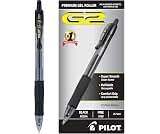
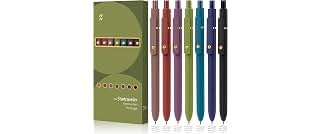
The Pilot G2 in 0.7mm black is the 0.7mm case done properly: a retractable, refillable body with a contoured grip, twelve to a box. It is the pen to buy if you want one answer and no further thinking. The FIOVER 0.5mm seven-pack is the other end of the scale, and it is deliberately built for quick-dry fine writing rather than for volume.
The pack-size trap: twelve black, fifteen rainbow, eight blue-black
This is where most pen money is wasted, and the packaging makes it hard to see. Three boxes, three different products:
One colour, many pens. The black 12-pack is a consumable purchase. You are buying the same reliable line twelve times, which is what you want if the pen is a tool you use up.
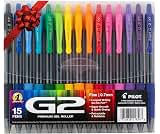
Many colours, few of each. The rainbow 15-pack is a colour-coding purchase. It is excellent for marking up a document, planning a week across colours, or bullet journaling, and it is a poor purchase if what you actually needed was a black pen, because most of the box is a colour you will use twice.
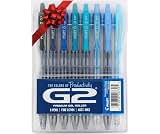
The middle case. The Boost blue 8-pack is assorted black and blue — the two colours people actually sign and annotate with. It is the sane choice for an office where documents are signed in blue and everything else is black.
So the question is not “how many pens do I need” but “how many colours do I need, at what quantity”. Answer that and the box chooses itself.
Gel versus felt tip: not the same tool with a different name
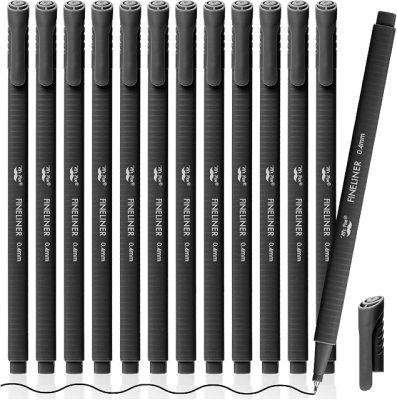
A gel pen is a ballpoint that leaks ink by gravity. A felt tip is a wick. The consequence is that the felt tip 12-pack behaves in ways gel cannot: the line is consistent from the first stroke to the last, it does not blob when you pause mid-sentence, and it does not smear on glossy or coated paper the way wet gel ink does.
What it gives up is darkness and the satisfying weight of gel ink, and it wears a flat spot if you press hard and hold it at one angle. Use felt tip for handwriting practice, lettering, diagrams, and anything on card stock. Use gel for notes, signatures, and forms. Neither replaces the other, which is why a drawer with only one type is a drawer that keeps failing at one job.
Quick-dry is a paper problem wearing a pen costume
“Quick-dry” sounds like an ink technology claim. In practice it is a statement about how the ink behaves on the paper you are using. Gel ink dries by absorbing into the sheet; on smooth, coated or recycled paper it sits on the surface and takes seconds longer, which is exactly when a left-handed writer drags a palm through it.
Two consequences worth knowing before you buy anything labelled quick-dry. First, if you are right-handed and writing on ordinary copy paper, the difference is small and you can save the premium. Second, if you are left-handed or writing on glossy stock, quick-dry matters enormously and is worth choosing deliberately — that is the case the 0.5mm quick-dry set is built for.
How many pens you actually need
Three. One at the desk, one that lives in the bag or jacket, and one spare in the drawer. The reason to hold three rather than one is not hoarding, it is that a pen which lives in a bag gets lent, lost or left in a meeting room, and the failure mode of owning exactly one pen is that you find out at the worst moment.
That argues for a small box of the same pen rather than a large box of assorted ones, unless colour coding is part of how you work. It also argues for refillable: a pen you refill is a pen whose body you keep, so the grip you liked on day one is still the grip you have in year two. Buying twelve sealed pens to avoid ever thinking about refills is a legitimate choice, but it is a choice, not a saving.
Where the pens live decides whether they survive
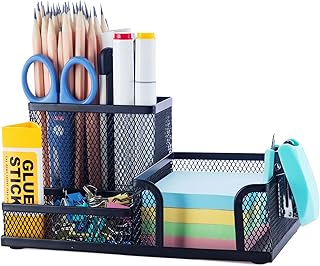
A gel pen left loose in a drawer with keys and a calculator dries out or gets its tip crushed, and the ones at the bottom of a bag leak onto whatever is under them. A holder is not decoration; it is what keeps the pen horizontal enough and upright enough to keep working.
The M&G three-compartment mesh holder is the small version: three sections, a tray for sticky notes, and enough weight in the mesh base that it does not slide when you pull a pen out one-handed. The EasyPAG six-compartment organizer with a drawer is the version for a desk that also has to hold clips, a stapler and the small things that otherwise migrate across the surface. Both are the same idea at two sizes, so pick by how much is currently loose on your desk, not by how much you wish was.
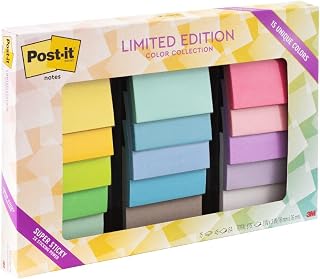
Worth pairing with the holder: a pad of 3×3 super sticky notes. The reason is mechanical rather than aesthetic — a note beside the holder is where the phone number goes, and if it is not within reach the number gets written on the back of something you needed.
What I would skip
A rainbow box as your only pen purchase. Fifteen colours sounds generous until you need a black line and the black is already dry in the drawer.
Extra-fine tips for general note-taking. Under 0.5mm is a specialist width for small writing on good paper. On a legal pad it feels like a needle.
Novelty pens with a shaped body. Cute for a week, uncomfortable in a long meeting, and they usually fail the refill test because no standard cartridge fits them.
Buying a pen holder before deciding the pens. The holder should be sized to what you actually keep, and most people buy the holder first, fill it with the wrong things, and then buy a second one.
The order to buy in
One box of 0.7mm black, refillable. That is the whole answer for most desks and it removes the question for the next year. Add a colour box only if colour is genuinely part of how you work — marking drafts, planning, or annotating — not because it looks good in a photograph. Add a felt tip pack if you letter, diagram or write on card. Then a holder, sized to the number of pens you now actually own.
If the desk itself is still being assembled, the screen height guide covers the one ergonomic fix that matters more than any accessory, the desk setup under $100 guide covers the mat, lamp and organizer in order of payoff, and the full guide index has the rest of the room-by-room builds. Pens are the last thing to optimise and the first thing to stop thinking about.
Products in this guide
The exact items referenced above. As an Amazon Associate we earn from qualifying purchases — details.
n
Disclosure: this site earns a commission from qualifying purchases made through the links below, at no extra cost to you.
Related reading
If this one was useful, the newer piece on Stocking a Small Shop for December Without Overbuying picks up where it leaves off. For the practical side, the Buying Guides page covers what we actually do day to day.
One question before you go: which of these steps is the one you keep putting off?
More buying guides
Products we would check first
Picked for this topic. Live price and availability are on the Amazon page — confirm there before you buy.
- PILOT G2 Premium Gel Roller Pens, Rainbow Assorted Color Ink 0.7mm, 15 Pack | Colored gel pens fine point, smooth, comfortable, quick drying and contoured grip gel pens for writing, assorted color inks Check price →
- PILOT G2 Premium Gel Pens, Fine Point 0.7mm, Black Ink, 12-Pack | G2 pilot pens, refillable and retractable ball, gel pens for journaling, writing pens, quick-drying ink, contoured grip Check price →
- Pilot G2 Premium Gel Roller Pens, G2 Boost Blue, Fine Point 0.7mm, 8-Pack | The colors of productivity, assorted black & blue ink pens, fine point pen 0.7 mm, rolling ball, & contoured grip Check price →
