
Home Improvement Guides
Drill or Impact Driver First? The Order to Buy Power Tools In
Nov
Disclosure: this site earns a commission from qualifying purchases made through the links below, at no extra cost to you. See our affiliate disclosure.
Almost every tool-buying decision in a first house comes down to one question that the packaging does not answer: what is the difference between a drill and an impact driver, and which do I need first? They look like cousins on the shelf. They behave nothing alike once a bit touches wood.
The difference in one sentence
A drill driver spins continuously and relies on your wrist to control how hard it pushes. An impact driver delivers rapid rotational strikes the way a hammer drill does axially — short bursts of torque instead of steady torque. That single mechanical difference decides what each tool is good at, and what each one will quietly ruin.
The drill holds a round-shaft bit in a keyless chuck and can therefore take a hole saw, a masonry bit, a mixing paddle, or a 1/2-inch auger. The impact driver holds a hex-shank bit in a quick-release collet. That means it cannot drill a clean hole in drywall without special hex-shank bits, and it cannot run a hole saw at all.
Buy the drill first if your list looks like this
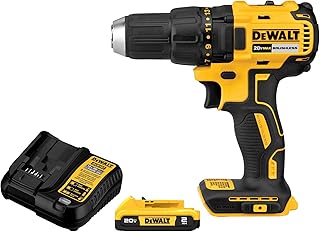
Shelves to hang, curtain rods to mount, a hole through a stud, furniture to assemble, a wall anchor that needs a pilot hole. This is drilling first and driving second, and drilling is the part an impact driver cannot do well. A 20V drill driver kit with two batteries covers it: DEWALT 20V MAX Cordless Drill Driver Set with Battery, Charger (DCD777D1) or, if you want the lighter current-generation body, DEWALT 20V Max XR Drill Driver, Battery and Charger (DCD771C2).
The kit is the part people skip. A bare tool plus one small battery looks cheaper until the battery dies halfway through a fence panel and the charger is a two-hour wait. Two batteries in the box is the difference between a tool you use and a tool you avoid.
Buy the impact driver first if your list looks like this
Deck boards, fence pickets, a shed kit, hundreds of screws, or anything where the screw head starts to cam out before it seats. An impact driver seats long screws with far less wrist strain and far fewer stripped heads, because the strikes do the work instead of your forearm. The current compact 1/4-inch body is DEWALT 20V MAX Impact Driver, 1/4 Inch, Battery and Charger Included (DCF787D1).
The honest answer for most people
If you are buying one tool to cover a house’s worth of small jobs, buy the drill driver. If you are buying one tool to cover a project — a deck, a fence, a run of cabinets — buy the impact driver. If you already know you will do both within a year, the combo kit is the cheaper path than buying twice: DEWALT 20V MAX Drill and Impact Driver (DCK277D2) puts both bodies on one battery platform, which is the whole point.
The battery platform trap
Tools are cheap; batteries and chargers are not, and they are brand-specific. Whatever you buy first commits you to that brand’s batteries for the next decade, so choose the platform rather than the single tool. This is also the reason a one-off cheap drill from an unknown brand is often the most expensive tool in the garage: the day its battery dies, the tool dies with it.
Buy these with it (in this order)
- A real bit set. The two bits in the box are a sample, not a set. A 45-piece driver set covers the Torx and square-drive heads that furniture and deck screws actually use: DEWALT Screwdriver Bit Set with Tough Case, 45-Piece (DW2166), Grey/Silver Screwdriving Set with Tough Case.
- A stud finder. Anchoring a shelf into drywall alone is how a shelf ends up on the floor. A wall scanner finds the stud and the live wire behind it: Stud Finder Wall Scanner.
- A small electric screwdriver. For flat-pack furniture and outlet plates, a full-size drill is comically overpowered and the clutch will still strip particle board. A USB-C screwdriver lives in a drawer and gets used weekly: Cordless Electric Screwdriver (USB-C).
- A magnetic screwdriver set for the jobs where a power tool does not fit — hinges, cabinet hardware, anything overhead: Magnetic Screwdriver Set (Multi-Bit).
- Storage that gets it off the floor. A wall rack is the cheapest way to stop a $200 tool living in a bucket: Wall Mount Tool Organizer Rack.
If you would rather buy one boxed kit than assemble the list, a compact household tool kit covers the screwdriver, pliers and hex-key jobs that the drill does not: HOTO 40-Piece Tool Kit for Home Improvement, Household Essentials & DIY | 14 Tools & 26 Accessories Tool Set, Smart Electric Screwdriver (LED, 3 Torque), Pro-Grade Compact Organizer.
What to skip at the start
Rotary hammers, 12-inch miter saws, and anything with a cord that only does one job. They are correct tools for specific projects and wrong tools for a first purchase — the money is better spent on batteries and bits that make the tool you already own work properly.
Quick answers
Can an impact driver drill holes? Only with hex-shank drill bits, and only in wood or thin metal. It will not drive a hole saw or a masonry bit, and it will wobble in drywall.
Do I need both? Not on day one. Once you have the drill, the impact driver is the second purchase that makes the first one last longer — you stop burning up the drill’s clutch on long screws.
What about a hammer drill? Only if you are drilling into brick or concrete. For drywall and wood it is extra weight with no benefit.
The short version
Drill driver first for a house, impact driver first for a project, combo kit if you already know you are doing both. Then spend the difference on a bit set and a stud finder, because a good tool with the wrong bit is still the wrong tool.
Where to buy
Everything referenced above is listed in our store — we only link to products we would recommend at the stated use:
Disclosure: this site earns a commission from qualifying purchases made through the links below, at no extra cost to you. See our affiliate disclosure.
More buying guides
