
Kitchen Guides
Instant-Read Thermometers: Why the $125 One Beats Three $25 Ones
Nov
Disclosure: this site earns a commission from qualifying purchases made through the links below, at no extra cost to you. See our affiliate disclosure.
Every kitchen ends up with a drawer thermometer that reads 165°F on a raw chicken breast and 140°F in a boiling pot. That is not user error, it is a cheap thermistor and a slow sample rate. Whether accuracy is worth paying for depends entirely on what you cook.
The four numbers on the spec sheet that matter
Response time. Two seconds versus eight is not a stopwatch fetish. On a thin pork chop the outside is already 20 degrees hotter than the centre, so a slow probe keeps reading the cooler part as heat conducts down the metal. You pull the meat late because the number is still climbing.
Accuracy. ±0.5°F versus ±2°F. Two degrees is the difference between 160 and 162 on a chicken thigh – fine – but also between 135 and 137 on a steak you wanted at 132.
Probe diameter. A 1.5 mm tip leaves a hole you cannot see. A 3 mm tip leaves a channel that leaks juice onto the board. On a chicken breast that is a visible difference.
Waterproofing. IP67 or better if you intend to wash it. Non-waterproof folding thermometers die at the hinge from steam, not from being dropped.
When the cheap one is genuinely fine
If your repertoire is whole roast chickens, a pot of chilli and a Sunday roast, a $20 probe is fine. Big thermal mass, slow cooking, and you are checking at the end anyway. Spend the money on a leave-in probe with an alarm instead – it does more for a roast than a faster handheld.
If you cook thin cuts – pork chops, chicken breasts, fish, steaks you actually want medium-rare – you are checking temperature while the window is open. That is where the two-second read earns its price.
The ice-water test, for any thermometer
Fill a glass with crushed ice, add water, stir for a minute, and probe the middle without touching the glass. It should read 32°F. If it reads 34, remember the offset – or use the calibration nut if the model has one. Do this the day you buy it and again in six months.
What we would buy
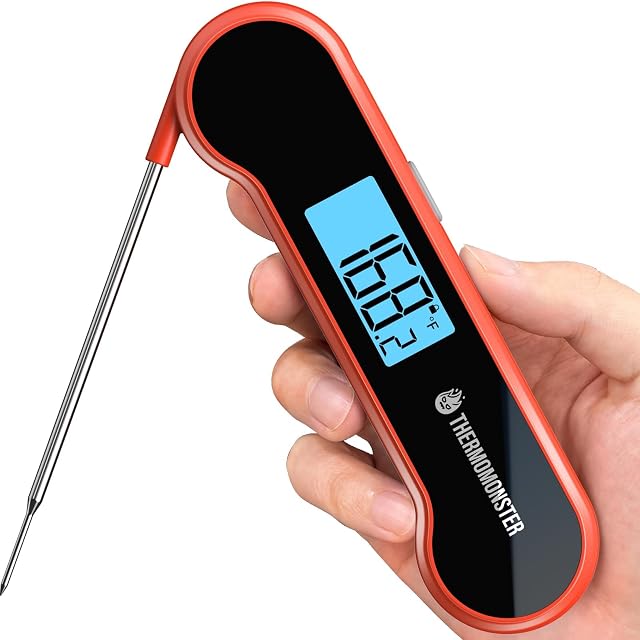
The Instant Read Digital Meat Thermometer is the model we point people at when they want the last thermometer they will buy: two-second read, ±0.5°F, folding probe, IP67, and it survives being left on a hot pan rim. It is also expensive enough that it should be a considered purchase, not an impulse one.
Cross-check the price before you decide: the same thermometer on Amazon. At the time of writing it sat around $125 – roughly four cheap thermometers. The argument for it is that you will not buy the four.
If that number is a no, the next best spend is a $25 instant-read plus a $15 leave-in probe, and use the leave-in for anything in the oven. That combination covers more cooking than one fancy handheld.
FAQ
Can I leave it in the oven? No. An instant-read is for spot checks; the probe and cable are not rated for ambient heat. A leave-in probe is a different tool.
Is 165°F required for chicken? For instant safety, yes. Pasteurisation is a time-and-temperature curve, so 150°F held for three minutes is also safe – but 165 is the number that needs no maths.
Why does mine read 10 degrees high? Usually the tip is too deep and touching bone or pan. Pull back a centimetre and read again before blaming the tool.
Where to buy
Everything referenced above is listed in our store — we only link to products we would recommend at the stated use:
Disclosure: this site earns a commission from qualifying purchases made through the links below, at no extra cost to you. See our affiliate disclosure.
More buying guides
